
If you work in communications, you’ve spent years building relationships with journalists, crafting narratives, placing stories, managing brand reputation across media channels. You know how to get a brand mentioned in the right places. You understand the difference between a placement that builds credibility and one that just fills column inches.
Here’s something worth knowing: that skill set transfers to GEO better than almost any other marketing discipline. The instincts that make a good PR professional — understanding what’s newsworthy, building credibility through third-party endorsement, creating content that journalists and editors actually want to use — are exactly the instincts that build AI citation authority.
This doesn’t mean GEO and PR are the same thing. They’re not. But communications teams are uniquely positioned to drive significant GEO impact if they understand where the leverage points are.
Why PR Signals Are Gold for AI Systems
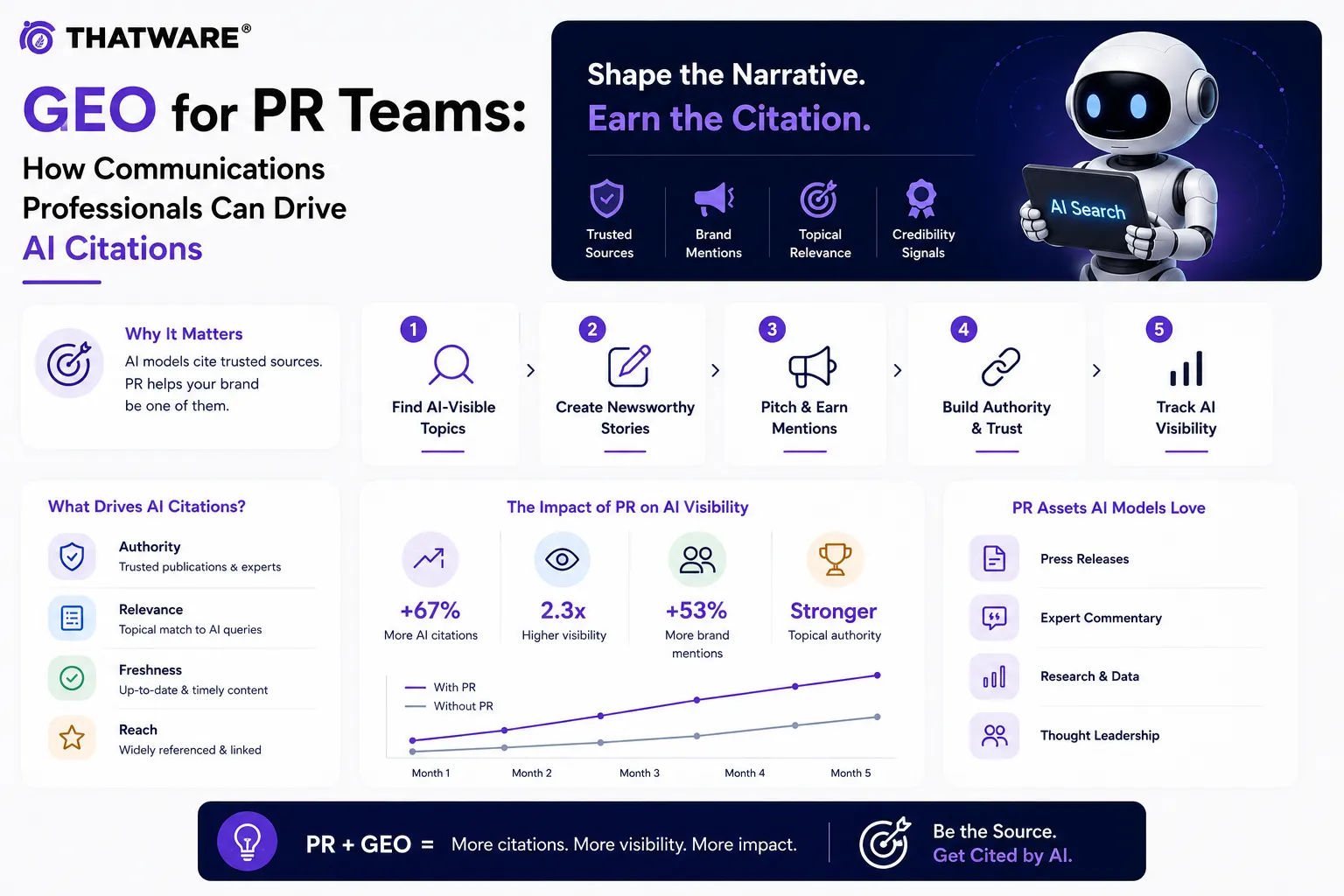
Let’s start with why PR work matters for GEO in the first place. AI systems, particularly retrieval-augmented systems like Perplexity and the AI that powers certain search features, draw heavily on web content that carries editorial credibility signals. Journalist-written articles that cite your executives as expert sources. Trade publication features that describe your company’s approach to a problem. Industry analysis that references your research or data.
These placements don’t just build brand awareness — they create the kind of authoritative external citations that AI systems treat as credibility indicators. When multiple credible sources consistently reference your brand in the context of a specific topic, the AI’s confidence in associating your brand with that topic increases.
This is, structurally, very similar to how PR has always worked for brand credibility. The mechanism is different (an AI retrieval system rather than a human reader forming impressions), but the underlying logic is the same: third-party endorsement from credible sources builds authority in ways that self-promotion never can.
Owned vs. Earned: Why Earned Still Wins
One nuance worth understanding for GEO purposes: the difference between owned media (content on your site) and earned media (coverage and citations in external publications) matters more for GEO than it did for traditional SEO.
Traditional SEO gives you significant control through on-site optimization. Your content, your schema, your internal architecture — these could move the needle significantly without a single external reference. GEO is less controllable that way. External citation signals carry disproportionate weight, which means the earned media work that communications teams are responsible for is directly feeding AI authority building.
Professional GEO services for brands that include a PR integration component tend to outperform those that treat content and PR as separate tracks. The brands getting cited most consistently in AI answers typically have both a strong owned content foundation and a steady stream of earned editorial placements.
Practical Moves for PR Teams
Pitching data stories. Original research and data are the PR content type most likely to generate AI-relevant citations. When journalists write about industry trends, they cite data sources. When those data sources are consistently attributed to your brand across multiple publications, that pattern becomes a strong entity signal. Developing a regular cadence of original research — even relatively modest surveys or benchmark reports — gives PR teams consistently pitchable material that also builds GEO authority.
Expert spokesperson development. AI systems respond to named individual authority, not just corporate brand authority. Developing two or three visible spokespersons within your organization — people with clear expertise in specific domains, consistently quoted in media coverage, with a track record of attributable positions — builds the personal authority signals that feed into your brand’s overall AI citation profile.
Press release optimization. Press releases are still distributed widely and often syndicated to sources that AI systems index. Structuring releases with clear who-what-where-why information, consistent brand and spokesperson identification, and specific attributable claims makes them more useful as AI-readable content. This isn’t a major lift — it’s mostly about structural discipline.
Targeting AI-indexed publications. Not all publications are equally indexed by AI systems. PR teams that develop a working knowledge of which outlets consistently appear in AI-generated answers within their category — and prioritize those outlets for placement efforts — get more GEO value from the same PR investment.
Managing Brand Framing in AI Answers
Traditional reputation management involves monitoring and responding to coverage that frames your brand negatively. For GEO, there’s an analogous challenge: how your brand is framed when it does appear in AI-generated answers.
Being cited is good. Being cited as a cautionary example, or in a defensive context, or with outdated information, is less good. Communications teams already have the skill set to address this — it’s essentially ongoing narrative management, applied to AI outputs rather than media coverage.
Monitoring how AI tools describe your brand across relevant prompts should be a regular practice, similar to media monitoring. When the framing is off — when AI consistently associates your brand with an outdated positioning or references old news — the corrective actions look like traditional PR: producing and amplifying new content that tells a different story, driving media placements that establish the updated narrative, and building the external reference set that AI systems draw from.
Crisis Communications in the GEO Era
One area where PR and GEO intersect in ways that are genuinely new: AI systems don’t forget. A significant piece of negative coverage, or a crisis that generated substantial media volume, can persist in AI-generated responses about your brand long after the traditional news cycle has moved on.
Increase AI citations agency work that involves reputation recovery recognizes this. The strategy isn’t just about managing current coverage — it’s about building a large enough body of positive, authoritative citation signals to dilute and eventually outweigh the negative references in AI training data and retrieval indices.
This is a longer game than traditional crisis communications, but the principles are familiar: flood the zone with accurate, positive, credibly sourced information. The channel is different; the discipline is the same.
The Opportunity for PR Professionals
Here’s the honest pitch for communications professionals thinking about GEO: this is an expansion of your existing remit that’s genuinely valuable, not a distraction from it. The skills you have — relationship building, narrative development, media relations, content creation — are exactly what GEO requires.
The addition is relatively modest: understanding the technical layer (how entity signals work, why structured data matters, how AI systems use external references), developing familiarity with the AI platforms your audience uses, and building GEO metrics into your regular reporting.
PR teams that develop this competency become significantly more valuable within their organizations — because they’re demonstrably building something that matters for business outcomes in a way that’s increasingly hard to separate from overall brand health.
The brand that gets cited consistently in AI answers about its category is the brand that wins research-stage consideration. PR teams, more than they may realize, hold many of the keys to making that happen.